The conversion of a varchar data type to a datetime data type resulted in an out-of-range value. LATEST BLOG Blogs
LATEST BLOG
Admin
2026-09-17

Here's something worth saying upfront: most students spend weeks comparing college programs, entrance cutoffs, and placement packages — and almost zero time thinking about the city they're about to spend four years living in.

That's a gap worth closing.

Where you study isn't just a postal address. It shapes who you meet, where you intern, how much you spend every month, and what job market you land in on the other side of graduation. And Kolkata — genuinely, honestly, without the tourism-brochure language — is one of the most undervalued student cities in India right now.

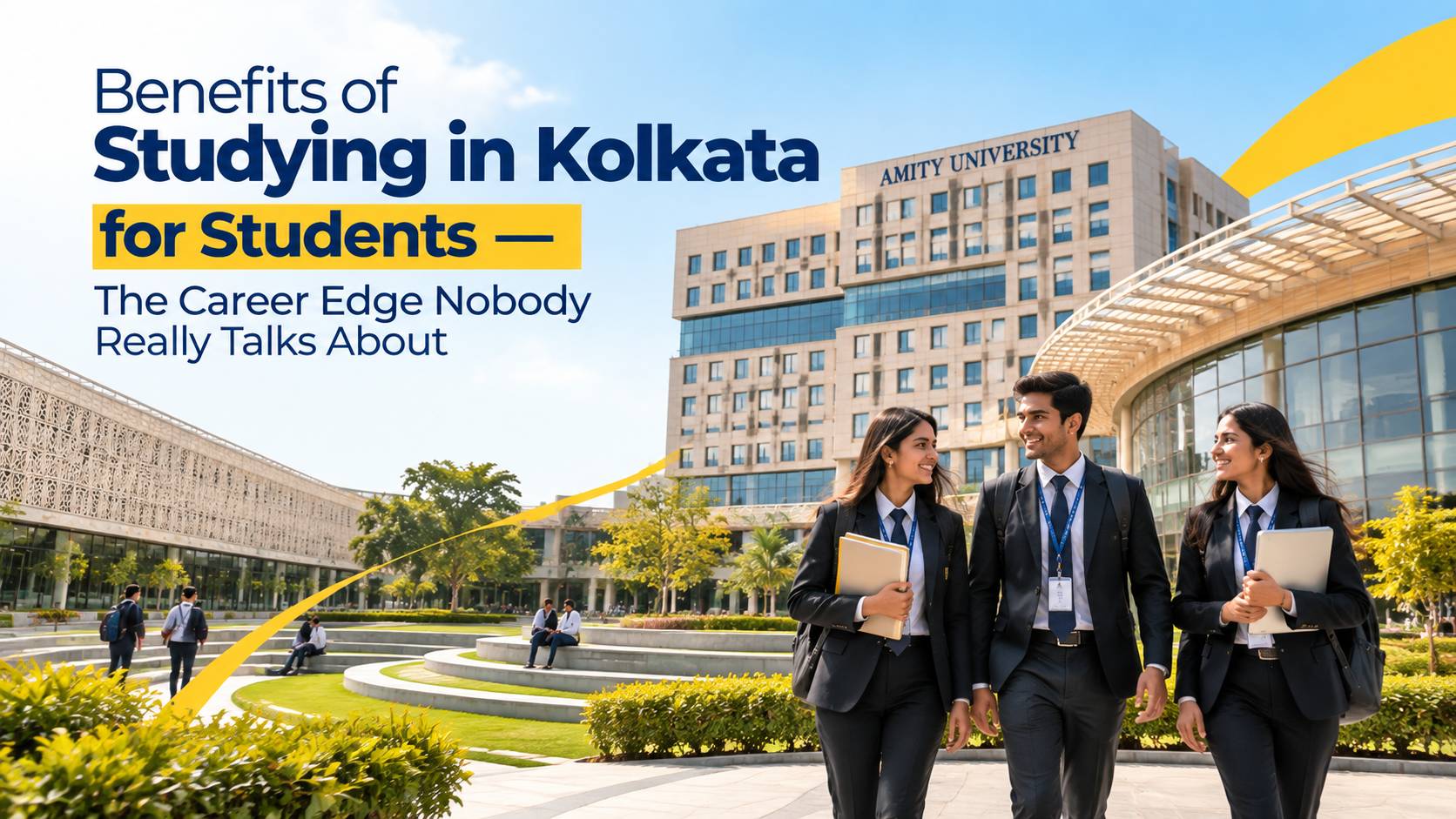
The benefits of studying in Kolkata for students run deeper than most families realize when they're shortlisting colleges. This post lays them out clearly — affordable living, real job access, what the Amity Kolkata location specifically offers, and why this city gives students a career edge that's harder to build from scratch anywhere else. 

The Money Side of It — And Why Kolkata Changes the Math Completely  

Let's be direct about this. Private university education is expensive. Most families feel that pinch from Day 1 of semester fees.

But here's something that doesn't show up in any fee comparison chart: the city you study in determines how much you spend on everything else. Rent, food, transport, weekend plans, textbooks — these aren't small numbers across four years.

Kolkata is genuinely, significantly more affordable than Bengaluru, Pune, Delhi, or Mumbai. And the gap isn't marginal — students who've lived in multiple cities consistently say the difference feels substantial.

Here's what it looks like in real numbers:

• A decent PG or room near New Town or Salt Lake — both close to the Amity Kolkata campus — runs ₹5,000 – ₹10,000 per month. The same in Bengaluru's Whitefield or Koramangala zones? Easily ₹13,000 – ₹22,000

• A proper meal at a local Kolkata restaurant costs ₹60 – ₹120. Most students eat well on ₹3,000 – ₹4,500 a month — without surviving on instant noodles

• Monthly metro, bus, and auto costs for a student rarely cross ₹1,500 in Kolkata

Add all of that up and a student in Kolkata can live comfortably on ₹12,000 – ₹18,000 per month. The same lifestyle in Bengaluru or Mumbai costs ₹22,000 – ₹32,000 easily.

Over a four-year program, that's a difference of ₹5 – ₹7 lakhs in living costs. That's not a rounding error. For families already stretching to cover private university fees, this number genuinely changes the financial calculation.

Something Nobody Actually Says About Affordable Cities  

There's a practical side to lower living costs that doesn't get written about much. Students who aren't constantly stressed about money — who aren't borrowing from friends to cover rent in the third week of the month — study differently.

They show up to workshops. They spend Saturday mornings doing certifications instead of taking extra gigs to cover expenses. They arrive at placement season with a clearer head.

Kolkata's affordability quietly supports academic performance in a way that high-cost cities simply can't replicate. Students from smaller towns who move here for the first time consistently say the city feels manageable — not overwhelming, not lonely, not financially suffocating.

Planning your monthly Kolkata budget before joining Amity? A realistic student breakdown for New Town, Rajarhat runs ₹5,000 – ₹10,000 for rent, ₹3,000 – ₹4,500 for food, ₹800 – ₹1,500 for transport, plus miscellaneous. Total: ₹12,000 – ₹18,000. One of the most student-friendly monthly costs of any major metro university zone in India. 

Kolkata's Job Market — It's Bigger Than the Stereotype Suggests  

Kolkata spent years carrying a reputation as a city whose best economic days were behind it. That reputation is outdated — and students who still believe it are missing something important.

The city has been quietly building a professional job ecosystem that's now substantial enough to matter for fresh graduates. Three sectors specifically are worth paying attention to.

IT and Technology — Salt Lake Sector V Is Right Next Door  

Salt Lake Sector V is Kolkata's equivalent of Bengaluru's Electronic City or Hyderabad's HITEC City — a concentrated IT employment hub with TCS, Wipro, IBM, Cognizant, and Infosys all running significant operations there.

For Amity Kolkata students studying B.Tech, BCA, or MBA, this isn't an abstract fact on a placement brochure. It's a 20-minute commute from the New Town campus. That proximity means internships in second year are realistic — not theoretical.

Students who intern at IT firms in Sector V during their program often graduate with either a PPO (pre-placement offer) or a strong referral connection before campus recruitment even opens. That's a head start that most students in more expensive or more remote campuses simply don't get.

BFSI — Kolkata Has Deep Banking History  

Kolkata is the headquarters city for several major public sector banks — United Bank and UCO Bank among them — and hosts active operations for HDFC Bank, ICICI Bank, Axis Bank, and Bajaj Finserv.

For Amity Kolkata MBA Finance and B.Com Banking graduates, this is their natural first job market. The BFSI sector in Kolkata hires consistently — and the competition for roles here is less intense than in Mumbai's Bandra Kurla Complex or Delhi's Connaught Place financial zones.

Consulting, E-commerce, and Logistics  

Deloitte, Ernst & Young, KPMG, and PwC all have Kolkata offices — and they recruit from Amity Kolkata's management programs. Amazon, Flipkart, and Naukri.com have also recruited from campus.

Eastern India's e-commerce expansion is creating steady demand for logistics, supply chain, and operations graduates. This is a sector that's growing faster in Kolkata's orbit than most students track when they're picking universities. 

The Amity Kolkata Location Advantage — New Town, Rajarhat Specifically  

This is worth a dedicated section because the specific location of Amity University Kolkata — New Town, Rajarhat — isn't just incidental.

New Town is the most planned and fastest-developing urban zone in Kolkata. It sits adjacent to Salt Lake Sector V, close to commercial corridors, and is well-connected to central Kolkata by metro and road. Studying at Amity Kolkata means your campus is physically inside one of the city's most active professional zones — not isolated from it.

What This Does for Internships  

The real career differentiator between two students with the same degree is often this: one did two meaningful internships during their program and one didn't.

Amity Kolkata's New Town location makes internships genuinely accessible from second year onward. The companies are close. The commute is short. The opportunities exist right outside campus in a way that campuses in remote suburbs or smaller cities can't match.

Students who secure internship roles in their second and third year consistently report better outcomes at placement time — stronger resumes, more confident interviews, sometimes direct PPO conversions that mean placement season becomes a formality rather than a source of anxiety.

Amity University Kolkata Placement Advantage — A Growing Recruiter Network  

Amity Kolkata's New Town address, combined with the Amity group's national brand recognition, makes it an attractive recruitment stop for companies that already have Kolkata operations.

The data backs this up. Top recruiters visiting the campus include Amazon, TCS, Wipro, Deloitte, KPMG, SAP, ZS Associates, HDFC Bank, Axis Bank, Cognizant, Byju's, and Naukri.com. The highest package recorded stands at ₹32.21 LPA, with other notable offers including ₹17 LPA from SAP and ₹15 LPA from ZS Associates.

The placement cell — Amity Centre for Career Development (ACCD) — runs on a three-pronged model: student preparation, industry-academia engagement, and final placement facilitation. Which means your placement preparation starts in Year 2, not Year 4.

If you're an outstation student considering Amity Kolkata, visit the New Town campus before deciding — not just the college, the neighbourhood. Check how far Salt Lake Sector V feels by metro. Walk around. Talk to students outside the official tour. The area itself is something you need to experience, not just read about. 

Why Choose Kolkata for Higher Education — The Things No Ranking Captures  

NIRF rankings measure research output, faculty credentials, and placement percentages. They don't measure what it actually feels like to grow into an adult in a particular city.

Kolkata does something for students that few other Indian cities manage quite the same way.

The Cultural Layer That Builds Real Communicators  

Kolkata is India's cultural capital — and that's not just a line for tourism brochures. The city has produced more writers, scientists, intellectuals, and national leaders per square kilometre than almost anywhere else in the country.

Living here as a student means casual exposure to theatre, literature festivals, film culture, and a tradition of serious public debate that you don't find in the same organic way in Bengaluru's tech-bubble environment or Pune's campus-centric bubble.

These things shape how you speak, how you think, and how you carry yourself in rooms. Employers hiring for management, consulting, and client-facing roles specifically look for candidates who can hold a conversation beyond their job description. Students who spent four years in Kolkata tend to develop this quality naturally — almost by accident.

The City Mixes People From Everywhere

Kolkata draws students from West Bengal, Assam, Bihar, Jharkhand, Odisha, and across India. Living and studying alongside people with genuinely different cultural backgrounds — different languages, different food, different references — builds cross-cultural communication skills in a way no classroom module can.

That skill shows up clearly when you manage a team from multiple states, handle clients from different regions, or move to a different city for work after graduation. It's the kind of thing that feels soft until your manager or a client actually notices it.

The Independence Factor  

Students who move to Kolkata, manage their own budget, navigate metro lines, build a social life outside their hometown, and handle everyday adult decisions — graduate with a practical independence that students who stayed close to home sometimes lack.

Kolkata teaches this without the financial anxiety of more expensive cities. A student on a reasonable monthly budget here can still eat well, build friendships, attend cultural events, and have a life that genuinely broadens their perspective — all within what most middle-class families can support without stress. 

Career Opportunities in Kolkata After Graduation — What the First Job Market Actually Looks Like  

Graduating in Kolkata puts you in a job market that's growing, less crowded than Bengaluru or Pune, and strongly connected to industries expanding across eastern India.

For Amity Kolkata graduates specifically, career paths after graduation include:

• IT roles at TCS, Wipro, Cognizant, and IBM's Kolkata development centres

• BFSI analyst and management roles at HDFC Bank, Axis Bank, ICICI Bank, and major NBFCs

• Consulting analyst positions at Deloitte, PwC, EY, and KPMG Kolkata offices

• E-commerce and logistics management at Amazon, Flipkart, and regional players

• FinTech and startup roles at NRI FinTech, Juspay, and growth-stage companies that specifically recruit from Amity Kolkata's campus

Job opportunities in Kolkata for freshers on platforms like Indeed and Naukri consistently show openings across IT support and development, digital marketing, financial analysis, content and media, and sales roles — with entry-level packages ranging from ₹3.5 – ₹6 LPA for most streams.

One structural advantage worth naming: Kolkata absorbs fewer fresh graduates than Bengaluru or Pune. A quality candidate from Amity Kolkata stands out more easily in the local job market than the same candidate would in a city where thousands of engineering and MBA graduates compete for the same 50 open roles every recruitment cycle. 

Conclusion

When families build college shortlists, they compare programs, fees, and placement numbers. The city almost never makes the list of things to evaluate seriously.

That's the gap this post tries to close.

The benefits of studying in Kolkata for students go well beyond affordable rent and decent food. The city offers genuine, proximity-based internship access, a growing professional job market across IT, BFSI, and consulting, a cultural environment that builds the whole person rather than just the graduate — and for Amity Kolkata students specifically, a location in New Town that sits directly inside one of eastern India's most active professional zones.

Combined with the ACCD's structured career development approach and an Amity brand that travels well across India, studying in Kolkata gives you a career edge that's practical, measurable, and often underestimated by students who never thought to ask about the city itself.

Ready to explore Amity University Kolkata for yourself? Visit the official website today, check eligibility and fees for your program, and plan a campus visit to New Town. Seeing the campus and the city together — on an ordinary Tuesday, not an open day — is the single best thing you can do before making this decision.


Frequently Asked Questions (FAQs)  

1. What are the main benefits of studying in Kolkata for students?

Kolkata offers significantly lower living costs than other Indian metros — typically ₹12,000 – ₹18,000 per month for students — a growing IT and BFSI job market, strong internship access via Salt Lake Sector V's tech hub, a culturally rich environment that builds well-rounded graduates, and a less competitive local job market where fresh candidates stand out more easily.

2. Is Kolkata a good city for higher education and long-term career building?  

Yes — Kolkata is one of India's top education cities, home to IIT Kharagpur, IIM Calcutta, Jadavpur University, and strong private institutions including Amity. The growing IT, BFSI, consulting, and e-commerce sectors provide consistent employment opportunities for graduates across multiple streams.

3. What is the Amity University Kolkata placement advantage of the New Town location?  

Amity Kolkata's campus in New Town, Rajarhat sits adjacent to Salt Lake Sector V — Kolkata's largest IT employment hub. This gives students realistic internship access from second year, shorter commutes to company offices, and makes the campus attractive for recruiters from Amazon, TCS, Deloitte, HDFC Bank, and others who already operate in the city.

4. What are the job opportunities in Kolkata for freshers after graduation?  

Fresh graduates in Kolkata find consistent openings in IT development at TCS, Wipro, and IBM; BFSI analyst roles at HDFC Bank and Axis Bank; consulting analyst positions at Deloitte and PwC; e-commerce and logistics at Amazon and Flipkart; and FinTech roles at growth-stage companies. Entry-level packages typically range from ₹3.5 – ₹6 LPA across most programs.

5. Is studying in Kolkata cheaper than Bengaluru or Delhi for students? 

Significantly cheaper. Monthly student living costs in Kolkata — including rent, food, and transport — run approximately ₹12,000 – ₹18,000. The equivalent in Bengaluru or Delhi easily reaches ₹22,000 – ₹32,000 or more. Over a four-year program, this difference can amount to ₹5 – ₹7 lakhs in living cost savings.

6. Why should outstation students choose Kolkata for higher education over other metro cities?  

Kolkata offers affordable living without sacrificing quality of life, a welcoming student culture, growing career opportunities in IT and BFSI, a city-wide intellectual and cultural tradition that builds better communicators, and less competitive job market dynamics. For Amity Kolkata students specifically, the New Town location and ACCD placement support make the city's advantages directly career-relevant from Year 2 onward.


Admin
2026-09-17

Most students who want a career in banking and finance make the same mistake: they pick a general commerce degree and hope for the best.

They graduate, look at job listings in investment banking, wealth management, or corporate finance, and suddenly realize the gap between what they studied and what employers actually want. That gap is painful — and completely avoidable.

If you're serious about building a career in the banking and finance sector, the program you choose from day one matters enormously. The banking and finance courses at Amity Kolkata are specifically built around this industry — with curriculum, certifications, and industry connections that general commerce degrees simply don't offer.

This post breaks down exactly what Amity Kolkata offers in banking and finance, what the placements look like, what salaries graduates are earning, and whether this path makes sense for your goals. 

What Banking and Finance Courses Does Amity Kolkata Actually Offer?  

Before we talk about careers and placements, let's be clear about what's on the table program-wise. Amity Kolkata runs dedicated banking and finance programs through the Amity College of Commerce & Finance, Kolkata — not just a finance elective tucked inside a general degree.

B.Com (Hons) — Banking and Capital Markets  

This is one of the most targeted undergraduate programs for students who know they want to work in financial markets, banking operations, or capital market roles straight after graduation.

• Duration: 3 years

• Eligibility: 10+2 with a minimum of 55% marks

• Total Fees: Approximately ₹6.12 lakhs for the full program

• Unique Feature: Students can pursue an additional online degree simultaneously — a UGC-approved provision that lets you build double qualifications within the same timeline

The curriculum covers banking operations, capital market instruments, financial regulations, investment analysis, and corporate finance fundamentals. It's built for students who want to sit across from a bank recruiter and actually understand what the job involves — not just hand over a general B.Com degree and hope the interviewer fills in the blanks.

MBA in Financial Technology (FinTech)  

For postgraduate students, Amity Kolkata offers an MBA in Financial Technology — a two-year program sitting right at the intersection of finance and technology.

This is increasingly relevant. The Indian banking sector is mid-transformation — digital payments, algorithmic lending, blockchain-based transactions, and AI-driven risk assessment are no longer future concepts. They're current job requirements.

Here's the detail that often makes a student stop scrolling and start filling the application form: the MBA FinTech program at Amity Kolkata includes hands-on lab work with real financial tools used in the industry. Students work with Python for Finance for quantitative analysis and algorithmic problem-solving, Tally for accounting and financial reporting, and — depending on lab availability — Bloomberg Terminal access for live market data analysis.

That last one deserves a moment. Bloomberg Terminal is what professional traders, investment bankers, and portfolio managers use every single day. Most students don't touch it until their second job — if ever. Getting familiar with it during your MBA year isn't a small thing.

An MBA FinTech graduate who walks into an interview having already worked with Python for financial modelling and Bloomberg data is a fundamentally different candidate from someone who only studied FinTech theory in a classroom.

MBA with Finance Specialization  

The broader MBA program at Amity Kolkata also offers Finance as a core specialization — covering investment management, corporate finance, risk analysis, and financial modelling.

Finance MBA graduates have been placed at companies including Deloitte, PwC, KPMG, HDFC Bank, Axis Bank, ITC, Nestle, and Flipkart. The most common roles offered include Senior Analyst and Assistant Manager — solid starting points for a finance career trajectory.

Interested in the MBA FinTech program specifically? Ask the admissions team which software tools are currently available in the lab — and whether Bloomberg Terminal access is active during your batch year. It's a small question that tells you a lot about how seriously the department invests in hands-on learning. 

How the Curriculum Actually Prepares You for the Finance Industry  

A program name means nothing if the curriculum doesn't deliver. Here's what separates Amity Kolkata's banking and finance pathway from a generic commerce degree.

Industry Collaboration Built Into the Program  

The B.Com Banking and Capital Markets program was developed in collaboration with the National Stock Exchange (NSE). This matters more than most students realize.

When a national stock exchange co-designs your curriculum, the syllabus reflects what the industry needs right now — not what it needed ten years ago. You're learning how markets actually function, how banking regulations are applied in practice, and how capital instruments work in real portfolios.

Think about what that means when you sit across from an HDFC Bank recruiter and they ask you about capital market instruments. You're not reaching back to a textbook chapter — you're drawing from a curriculum literally written with market practitioners.

Certifications That Follow You Into Interviews  

Beyond the degree itself, Amity Kolkata's finance programs build in opportunities for industry certifications — in financial modelling, risk management, and capital market analysis.

Walk into a banking interview with an NSE certification alongside your finance degree, and you immediately separate yourself from candidates carrying a plain B.Com. Recruiters from HDFC Bank, Federal Bank, and Mahindra Finance — all of whom recruit from Amity Kolkata — notice that difference.

Faculty Who've Actually Worked in Finance  

Several professors across Amity Kolkata's finance programs bring real industry backgrounds into their teaching — having worked in banking, investment firms, or regulatory bodies before joining academia.

When someone who's actually managed a real investment portfolio explains portfolio risk, it lands differently than a chapter in a textbook. Students consistently mention in reviews that this faculty quality is one of the things they didn't expect — and ended up valuing most. 

Amity University Kolkata Placements for Finance — What Are Graduates Actually Earning?  

This is the section most students jump to first. Here's the honest picture.

Amity University Kolkata placements for finance and management streams show a realistic average package range of ₹5 – ₹9 LPA, depending on the specific program and role. Top performers in MBA Finance consistently exceed this range with offers from consulting and BFSI sector firms.

Here's a program-wise breakdown:

Program

Average Package

Top Packages

Key Recruiters

MBA Finance / FinTech

₹5 – ₹7 LPA

₹12 – ₹17 LPA+

Deloitte, PwC, KPMG, HDFC Bank

B.Com Banking & Capital Markets

₹3.5 – ₹5 LPA

₹7 LPA+

Federal Bank, Mahindra Finance, Axis Bank

General MBA (Finance elective)

₹4.5 – ₹6 LPA

₹10 LPA+

TCS, IBM, Cognizant, Deloitte


Figures sourced from Careers360, CollegeDunia, CollegeDekho, and student reviews. Always verify current data directly with Amity Kolkata's placement office.

Finance Jobs After Amity University Kolkata — What Roles Are Graduates Actually Taking?  

The most common job titles that Amity Kolkata finance graduates step into include:

• Financial Analyst — at consulting firms, banks, and NBFCs

• Senior Analyst — in BFSI sector companies including Deloitte and PwC

• Assistant Manager (Finance) — at companies like HDFC Bank and Axis Bank

• Investment Banking Analyst — for higher-performing MBA Finance graduates

• Risk Analyst — increasingly in demand at fintech companies and large banks

• Credit Analyst — at NBFCs and private sector banks

• FinTech Product Analyst — a newer role that MBA FinTech graduates are particularly well-positioned for

The Amity Kolkata average salary for finance graduates sits around ₹5 – ₹6 LPA at entry level. Finance professionals from private universities in India with 4–6 years of BFSI or consulting experience typically reach ₹12–20 LPA — and those who move into fintech or investment banking see faster salary growth than most sectors.

Ask the Amity Kolkata placement office for the finance-specific placement report — not the overall university numbers. Program-specific data gives you the clearest picture of what your starting salary and first employer could realistically look like. 

Career in Banking After Amity Kolkata — The Paths That Actually Open Up  

A career in banking after Amity Kolkata isn't a single straight line. It branches in several directions — and knowing which branch fits your interests early helps you make the most of your program years.

The Corporate Banking and BFSI Path  

Students who graduate from MBA Finance or B.Com Banking and Capital Markets and join HDFC Bank, Federal Bank, Mahindra Finance, or Axis Bank typically enter as management trainees or junior analysts.

The progression in banking is structured — analyst to senior analyst to manager typically happens within 5–7 years for consistent performers. An Amity degree combined with an NSE certification significantly strengthens your candidacy for these roles compared to a general commerce graduate.

The Consulting and Financial Services Path  

Firms like Deloitte, PwC, KPMG, and ZS Associates recruit from Amity Kolkata's management programs with regularity. These firms pay well, promote fast for strong performers, and give finance graduates exposure to multiple industry clients within the first two years — building breadth of experience that purely banking roles don't offer at an early stage.

The FinTech and Startup Path  

This is the fastest-growing career track right now. If you're studying MBA FinTech at Amity Kolkata, you're positioning yourself directly for roles at payment companies, digital lending startups, WealthTech platforms, and InsurTech firms.

The Python for Finance and Bloomberg Terminal exposure from your program years makes you immediately more useful to a FinTech employer than a traditional MBA graduate who needs six months of on-the-job training to catch up on the technical basics.

Companies like Juspay and NRI FinTech have both recruited from Amity Kolkata's campus. These aren't household names yet — but they're the kind of growth-stage companies where a career can accelerate faster than at a large traditional bank.

The Higher Studies Path  

Several Amity Kolkata finance graduates go on to pursue CFA, CPA, or CA qualifications after their degree — or pursue master's programs in finance in the UK, Australia, and Canada. The Amity degree is internationally recognized, which removes one obstacle from overseas university applications that students from lesser-known institutions often face. 

Conclusion  

If your goal is a career in banking, capital markets, financial consulting, or FinTech — the banking and finance courses at Amity Kolkata give you a much stronger foundation than a general commerce degree.

The NSE-collaborated curriculum, Python and Bloomberg lab work in the FinTech program, industry-experienced faculty, and the range of BFSI roles that Amity Kolkata finance graduates actually step into — all point in the same direction. This is a program built with your first job in mind, not just the certificate at the end.

Starting salaries of ₹5–7 LPA, top offers in the ₹12–17 LPA range, and mid-career earning potential that reaches ₹20 LPA+ make a reasonable case for the investment. The students who get the most out of it are the ones who pair the degree with certifications, engage the placement cell from Year 1, and arrive ready to use the tools — not learn them from scratch in their first job.

Ready to take the next step? Visit the official Amity University Kolkata website today, check current eligibility and fees for your preferred finance program, and get your 2026 application in before the scholarship window closes. 

Frequently Asked Questions (FAQs)  

1. What banking and finance courses does Amity Kolkata offer?  

Amity Kolkata offers B.Com (Hons) in Banking and Capital Markets — a 3-year undergraduate program developed in collaboration with the NSE — and MBA in Financial Technology (FinTech) at the postgraduate level. MBA with Finance specialization is also available, run through the Amity College of Commerce & Finance, Kolkata.

2. What hands-on tools do students use in the MBA FinTech program at Amity Kolkata?  

The MBA FinTech program includes practical lab work using Python for Finance for quantitative analysis and algorithmic problem-solving, Tally for financial reporting, and Bloomberg Terminal access for live market data analysis. These are tools used by finance professionals in actual jobs — not just academic exercises.

3. What is the Amity Kolkata finance placement record for MBA students?  

MBA Finance and MBA FinTech graduates from Amity Kolkata see average packages in the ₹5–7 LPA range, with top offers from Deloitte, PwC, KPMG, and HDFC Bank reaching ₹12–17 LPA. Common roles include Financial Analyst, Senior Analyst, and Assistant Manager in BFSI and consulting firms.

4. What is the Amity Kolkata average salary for finance graduates?  

Entry-level average salaries for finance graduates typically sit between ₹5–9 LPA depending on the program and recruiter. Mid-career finance professionals with 4–6 years of experience who move into consulting or senior BFSI roles commonly earn ₹12–20 LPA.

5. Which companies hire finance graduates from Amity University Kolkata?

Top finance sector recruiters at Amity Kolkata include HDFC Bank, Axis Bank, Federal Bank, Mahindra Finance, Deloitte, PwC, KPMG, ZS Associates, SAP, NRI FinTech, and Juspay. Management programs with finance specializations also see recruitment from Amazon, TCS, and IBM.

6. What makes Amity Kolkata's B.Com Banking and Capital Markets different from a regular B.Com?  

The program was developed in collaboration with the National Stock Exchange (NSE), meaning the curriculum reflects actual capital market requirements. Students can also pursue an additional online degree simultaneously under a UGC-approved dual-degree provision — building double qualifications within the same program duration.

Admin
2026-09-17

There's a moment in every college decision where the excitement starts to outpace the thinking.

Your child has the campus tour saved, the program brochure bookmarked, and a mental picture of their hostel room already decorated. And somewhere in all of that — you, as a parent, are quietly wondering whether you've actually asked everything you should have.

Most families walk into the Amity University Kolkata admission process knowing two things: the course name and the deadline. The questions that really matter — eligibility details, real placement data, which fee category your child falls into, what students actually think after three years there — tend to come up after the seat is confirmed. By then, some of those answers sting more than they should.

This post is built around 10 questions that deserve answers before you commit. Let's go through them one by one. 

Questions 1 to 3 — Eligibility, Fees, and the Category Nobody Warns You About  

Get these three right first. Everything else builds on them.

Question 1: Does My Child Actually Meet the Eligibility Criteria?

This sounds obvious. But admissions teams field calls every season from families who assumed their child qualified — and found out too late they didn't.

Here's the Amity Kolkata eligibility criteria across the programs students most commonly ask about:

Program

Minimum Qualification

Minimum Marks

Entrance Required

B.Tech

10+2 with PCM

55% aggregate

JEE Main or Amity JEE

MBA

Graduation (any stream)

50% aggregate

CAT / MAT / XAT / NMAT / Amity WT + PI

BBA

10+2 (any stream)

50%

Merit / CUET-UG

BBA LLB (Hons)

10+2 (any stream)

50%

Merit / CUET-UG

BCA / BCA (Hons)

10+2 with Maths/CS

50%

Merit / CUET-UG

M.Tech

B.Tech (relevant stream)

55%

GATE score


One detail that genuinely surprises people: if your child scores 80% or above in Class 12, they may qualify for direct admission to BCA, BBA, BBA LLB, and MA programs — without sitting for any separate entrance test. That's a door worth knowing about.

Question 2: What Will We Actually Pay, and Can We Reduce It?  

The application fee is ₹1,500 — non-refundable, paid upfront. That's not the number your family needs to plan around, though.

Annual fees range from roughly ₹80,000 for arts and science programs to ₹7.33 lakhs for MBA. B.Tech typically sits between ₹1.88 – ₹2.97 lakhs per year.

But here's the thing most families discover too late: merit-based scholarships can bring those numbers down by 25% to 50%. The scholarship window opens with the first admission round and closes as seats fill. Students who ask about scholarship eligibility early — before admission, not after — almost always end up in a better financial position than those who assume the listed fee is fixed.

One conversation with the admissions office before you apply can save your family a meaningful amount of money over four years.

Question 3: Which Admission Category Will My Child Fall Into?

This is the question almost nobody asks — and it absolutely should be asked.

Amity Kolkata admits students under two categories: Non-Sponsored (higher merit, lower fee) and Sponsored (lower merit, higher fee). The fee difference between the two categories can be substantial, and knowing which one your child's scores place them in before applying removes one very unpleasant surprise from the process.

Ask the admissions team clearly: "Based on my child's current scores, which category would they be admitted under?" It's a direct question. Any admissions office worth trusting will give you a direct answer.

Before filling the application form, call the Amity Kolkata admissions office and get clear answers on all three questions above. It takes 15 minutes and saves weeks of back-and-forth later. 

Questions 4 to 6 — What the Admission Process Actually Involves

Knowing what's coming makes the whole thing less stressful — for your child and for you.

Question 4: What Happens After I Apply?  

Here's the step-by-step of how Amity Kolkata admission actually works:

  1. Apply online at the official Amity Kolkata website, pay the ₹1,500 application fee

  2. Submit your qualifying exam scores — JEE Main, CAT, CUET-UG, or Amity's own entrance test depending on your program

  3. Receive shortlist notification and attend a personal interview or counseling session (available online for most programs)

  4. Complete document verification — marksheets, identity proof, category certificates if applicable

  5. Pay the initial fee installment to confirm your seat

  6. Receive your admission confirmation and joining instructions

The entire process runs online for most programs, which genuinely helps families applying from outside Kolkata.

Question 5: Can My Child Get In Without Any Entrance Exam?  

For several programs — yes.

BCA, BBA, BBA LLB (Hons), and MA programs offer direct merit-based admission for students who score 80% or above in Class 12. No separate entrance test required.

For B.Tech, a JEE Main or Amity JEE score is necessary. For MBA, a national entrance test plus personal interview is standard.

When you speak with admissions, ask specifically: "Does my child's Class 12 percentage qualify them for direct admission?" You might be pleasantly surprised by the answer.

Question 6: Which Dates Cannot Be Missed?  

Amity University Kolkata admissions for 2026-27 are open right now. But dates matter — specifically:

• Scholarship application deadline (the one that costs money if missed)

• Entrance test schedule for your specific program

• Personal interview or counseling window

• Seat confirmation fee payment cutoff

Pin down the scholarship deadline first. Missing an exam date is recoverable. Missing the scholarship window costs your family real money that can't be recovered later. 

Questions 7 and 8 — What Placements Actually Look Like on the Ground  

This is where families need honest information — not headline numbers.

Question 7: What Are the Real Placement Numbers for My Program Specifically?  

The highest placement package at Amity Kolkata stands at ₹32.21 LPA. Other strong offers include ₹17 LPA from SAP and ₹15 LPA from ZS Associates. The university has supported over 52,000 campus placements through its placement cell over the years.

Those peaks matter, but averages tell the fuller story. For most programs, the realistic starting range sits between ₹4.5 – ₹6 LPA — with B.Tech CSE and MBA graduates consistently at the higher end.

The question you must ask the admissions team — and insist on getting an answer to: "Can I see last year's placement report specifically for this program?"

Overall university placement numbers blend strong streams with weaker ones. The program-specific report is the number your family should be making decisions from.

Question 8: Which Companies Actually Came to Campus Last Year?  

Top recruiters at Amity Kolkata include Amazon, TCS, IBM, Cognizant, SAP, ZS Associates, Deloitte, KPMG, HDFC Bank, ICICI Bank, NRI FinTech, and Flipkart.

But don't stop at the recruiter list. Ask a current third-year student from your child's department: "How many companies came to your batch — and what were the actual roles they hired for?" That answer tells you far more than any official list.

Ask the placement cell for last year's program-specific placement report before paying any fee. A university that hesitates to share that document with a serious applicant is, in itself, an important piece of information. 

Questions 9 and 10 — What Students Say, and Whether You Should Actually Do This  

These two questions cut to the heart of the whole decision.

Question 9: What Do Current Students Honestly Say About Being There?

Amity University Kolkata holds a 4.1 out of 5 rating from 246 verified student reviews on Shiksha — and that number comes from students who lived the experience, not the admissions team.

Across Shiksha, CollegeDunia, Careers360, and Zollege, a few consistent themes appear in honest reviews:

What students genuinely value:
Faculty who are approachable and actually accessible outside class hours — this gets mentioned more than anything else. A campus in New Town, Rajarhat that's modern, clean, and well-equipped. Hostel facilities that female students particularly highlight as comfortable and safe. A canteen that outstation students describe as affordable and reasonably good — which matters more than people expect when you're living away from home for the first time. Cultural events and student fests that build real confidence in ways the classroom simply can't.

What honest reviews also mention:
Some compulsory subjects — stress management, history — showing up inside technical programs in a way that students find disconnected from their actual course. The 75% attendance rule creating genuine stress during illness or family situations. Lift maintenance on campus flagged more than once. Club selections occasionally feeling like an inside track for existing members' friends.

None of these are reasons to walk away. But knowing them ahead of time means your child arrives prepared — not blindsided.

Question 10: Is Amity University Kolkata Actually Good for Your Child's Specific Goals?  

Here's the honest answer — not the diplomatic one.

For B.Tech CSE, AI, and MBA: the infrastructure, faculty, placement support, and Amity brand recognition all line up well. The ROI math holds up, the recruiter list is serious, and the degree carries genuine weight across India. For students going into tech or management, Amity Kolkata is a genuinely strong choice.

For non-IT engineering, B.Sc, and arts programs: placement outcomes are more variable. Starting salaries are lower, and fewer core-sector companies recruit in those streams. That doesn't make Amity Kolkata a bad choice for those programs — but it does mean your child needs to be more proactive about building their career themselves.

For students in these streams specifically — here's what makes the difference. The Amity Innovation Incubator and student clubs like the entrepreneurship cell, the media and communication society, and research groups exist exactly for students whose career paths aren't paved by mass campus recruitment. Students who plug into these communities early — building projects, entering competitions, publishing research, and creating a portfolio — consistently leave with more to show than their peers who waited for placements to arrive.

The message at Amity Kolkata is the same regardless of stream: it's what you make of it. The university gives you infrastructure, faculty, and access. What your child builds on top of that is entirely up to them. 

Conclusion

The families who feel best about the Amity Kolkata decision — whether they chose it or ruled it out — are the ones who asked these questions before they decided, not after.

Amity University Kolkata admission is open for 2026. The faculty is real, the campus is solid, the brand travels well, and the placement cell works harder than most. But none of that replaces the honest conversation you need to have before the seat is confirmed.

Ask every question on this list. Push for program-specific answers. Talk to current students, not just the admissions team. And then decide with your eyes fully open.

Start with the official source — visit the Amity University Kolkata admissions page today, check your program's eligibility and current scholarship criteria, and get your 2026 application moving. The earlier you ask, the better your options. 

Frequently Asked Questions (FAQs)  

1. What is the Amity University Kolkata admission process?  

The process runs fully online. You apply on the official Amity Kolkata website, pay a ₹1,500 application fee, submit your entrance exam scores, attend a counseling or interview session, complete document verification, and confirm your seat by paying the initial fee installment. Most steps can be completed without visiting Kolkata in person.

2. What is the Amity Kolkata eligibility criteria for B.Tech and MBA?  

For B.Tech, you need 10+2 with PCM and a minimum 55% aggregate, plus a valid JEE Main or Amity JEE score. For MBA, you need graduation with at least 50% marks and a valid CAT, MAT, XAT, NMAT, or Amity written test score, followed by a personal interview.

3. Is Amity University Kolkata good or bad for placements?  

It depends on the program. B.Tech CSE, AI, and MBA students see the strongest placement outcomes, with top packages reaching ₹32.21 LPA and averages between ₹4.5–6 LPA. Non-IT and arts streams see more variable results. Always ask for the program-specific placement report before deciding.

4. What do students say in Amity University Kolkata reviews?  

Amity Kolkata holds a 4.1/5 rating from 246 verified reviews on Shiksha. Students consistently praise faculty accessibility, campus infrastructure in New Town, and student events. Honest feedback includes some irrelevant course subjects, a strict 75% attendance rule, and variable placement results across programs.

5. Can a student get direct admission to Amity University Kolkata without an entrance exam? 

Yes — for BCA, BBA, BBA LLB, and MA programs, students who score 80% or above in Class 12 may qualify for direct merit-based admission without sitting for a separate entrance test. B.Tech and MBA still require entrance exam scores.

6. Should I take admission in Amity Kolkata or consider other options?  

If your child is targeting B.Tech CSE, AI, or MBA — and they're ready to stay actively engaged throughout the program — Amity Kolkata is a strong choice. For other streams, compare program-specific placement data carefully with two or three alternatives before committing. The university is UGC-recognized, NAAC-accredited, and ranked #1 private university in West Bengal by Times Higher Education 2026.

Admin
2026-09-17

My neighbour called me last month, slightly stressed. Her daughter had just come home from school, sat down at the dining table, and announced: "Amma, I want to go to Amity Kolkata."

The daughter had done her research. She had screenshots, YouTube videos, and a whole argument prepared. The mother had one question she couldn't shake: "But is it actually worth what they're asking us to pay?"

If that conversation sounds familiar — you're in the right place.

Is Amity University Kolkata worth it? This post answers that question the way one parent would answer another. No marketing language, no vague promises. Just fees, real placement numbers, honest student reviews, and a clear sense of what your family is actually investing in. 

Let's Start With the Money — Amity University Kolkata Fees Structure

Because that's where every parent's mind actually goes first, and pretending otherwise wastes everyone's time.

Amity University Kolkata sits in New Town, Rajarhat — one of Kolkata's fastest-growing urban zones with solid connectivity to the city's IT and business districts. The campus looks impressive, and it should — the fees reflect that investment.

Here's what you're looking at across the most popular programs:

Program

Total Course Fee (Approx.)

Annual Fee (Approx.)

B.Tech (CSE / AI)

₹7.52 – ₹11.88 Lakhs

₹1.88 – ₹2.97 Lakhs

MBA

₹9.10 – ₹14.67 Lakhs

₹4.55 – ₹7.33 Lakhs

B.Sc (Hons.)

₹2.43 – ₹6.40 Lakhs

₹0.81 – ₹2.13 Lakhs

LLB

₹7.14 – ₹9.55 Lakhs

₹1.43 – ₹1.91 Lakhs


Fees are approximate and may be revised annually. Confirm the current figures directly on the official Amity University Kolkata website before making any decisions.

Yes — these are private university numbers. Comparing them to Jadavpur or Presidency isn't apples-to-apples, and you know that. The real question isn't "why is it expensive?" — it's "what exactly am I paying for?"

The Scholarship Conversation Most Parents Skip

Here's something the admissions brochure buries in small print: Amity Kolkata offers merit-based scholarships that can bring your annual fee down by 25% to 50%.

If your child scored above 85% in boards, or carries a strong JEE or CAT score, the first call you make should be asking specifically about scholarship eligibility for their program. Don't wait until after admission. Ask during your first inquiry call.

Students who apply in the opening window of admissions almost always have better scholarship outcomes than those who come in the second or third round — because scholarship budgets deplete as seats fill.

Call the Amity Kolkata admissions office this week and ask directly: "What scholarships are available for [program name] and what's the eligibility?" One 10-minute call could save your family ₹1–2 lakhs per year. 

Amity Kolkata Fees and Placement — Does the Investment Actually Pay Back?

This is the ROI question. You're committing four years and a significant amount of money — what does your child walk away with, and how long before they earn it back?

Let's put actual numbers to it.

The highest placement package recorded at Amity Kolkata stands at ₹32.21 LPA. Other notable offers include ₹17 LPA from SAP, ₹15 LPA from ZS Associates, and ₹12.55 LPA from Cozeva. The university has supported over 52,000 campus placements through its placement cell over the years.

For most graduating students, the realistic starting range looks like this:

• B.Tech (CSE / AI): ₹4.5 – ₹7 LPA average, with top performers going ₹8–10 LPA+

• MBA graduates: ₹5 – ₹7.22 LPA from BFSI, consulting, and marketing firms

• B.Sc graduates: ₹2.5 – ₹4 LPA for science and research roles

The Simple Math a Parent Actually Does  

Take B.Tech CSE. Total investment: roughly ₹10–12 lakhs over four years. Starting salary: ₹5 LPA. After one appraisal in year two, they're at ₹6–7 LPA. By year three, ₹8 LPA isn't unrealistic at a decent IT firm.

Your entire investment pays back within 2.5 to 3 years of their first job. That's before any promotions, skill upgrades, or job switches — all of which typically push salaries higher.

That's a reasonable Amity University Kolkata ROI — especially when you consider that the degree comes from a university ranked #1 Private University in West Bengal by Times Higher Education Asia University Rankings 2026.

Career Trajectory — What the Growth Looks Like Over Time

Starting salary matters, but career trajectory matters more. Here's a realistic 10-year picture based on where Amity Kolkata alumni actually land:

• Years 1–2: Entry-level at TCS, Wipro, Cognizant, or a mid-size IT firm — ₹4.5–6 LPA

• Years 3–5: First promotion or job switch — ₹8–12 LPA is common in IT; ₹10–15 LPA in consulting

• Years 6–10: Senior roles, team lead, or managerial positions — ₹15–25 LPA+ depending on sector and ambition

MBA students on the BFSI or consulting track tend to see a steeper early curve — slower start, but faster acceleration after the first role.

Students who use their Amity years to build certifications, do internships from second year, and build a LinkedIn presence before graduation consistently outperform their batchmates who wait until placement season to start thinking about careers. 

What Real Students and Parents Say — Amity University Kolkata Review  

Numbers give you structure. Reviews give you texture. And texture is what actually helps you make a decision with confidence.

Amity University Kolkata holds a 4.1 out of 5 rating from 199 verified student reviews on Shiksha.com. That's not a number the university controls — it's students who studied there, sat through the good days and the frustrating ones, and still chose to give it 4.1.

What Students Genuinely Appreciate

Across Shiksha, CollegeDunia, Careers360, and various forums, a few things come up consistently in honest Amity University Kolkata reviews:

Faculty who've actually worked in the real world. Several professors bring industry backgrounds into their teaching — which makes a noticeable difference when students start preparing for placements and interviews. It's one thing to learn about marketing strategy from a textbook. It's another to hear it from someone who ran campaigns at an actual company.

The campus itself. The New Town, Rajarhat location gives students access to a modern, well-equipped campus with labs, library, sports complex, hostels, and a cafeteria that most outstation students describe as genuinely comfortable. For parents worried about their child living away from home — New Town is a safe, well-connected neighbourhood with good transport options into central Kolkata.

The placement cell's year-round presence. Rather than a last-minute flurry in final semester, the CRC at Amity Kolkata runs mock interviews, aptitude workshops, resume clinics, and industry certifications throughout the academic year. Students who engage with this preparation consistently report better placement outcomes.

What the Honest Reviews Also Mention  

A Reddit thread from a Kolkata community forum put it plainly: "Decent faculty, solid infrastructure, good discipline — but placement in some streams is weaker than others."

That's fair, and it's worth saying here. Non-IT engineering streams and some arts programs see lower average placement packages than CSE or MBA. If your child is planning a B.Sc in Chemistry or a humanities program, the placement numbers aren't as strong — and career paths often require additional qualifications or competitive exams after graduation.

The students who come out most satisfied from Amity Kolkata, based on every review platform, share one consistent trait: they showed up. They attended the workshops when they weren't mandatory. They applied for internships in second year instead of third. They networked with alumni before placement season opened. The university gave them the infrastructure — they chose to use it.

Before you confirm admission, ask the admissions team to connect you with a second or third-year student from your child's specific program. Not a faculty member, not a placement coordinator — a current student. That 20-minute call will tell you more than any brochure. 

Amity Kolkata Average Salary and the Bigger Question of Long-Term Value

Starting salary is a useful data point. But it's not the whole picture — and as a parent, you probably know that.

The Amity Kolkata average salary at entry level sits around ₹5 LPA for most programs. But here's the question that actually matters: where are graduates five, seven, ten years out?

Where Amity Kolkata Alumni End Up

Top recruiting companies at Amity Kolkata include Amazon, Flipkart, TCS, IBM, Cognizant, SAP, ZS Associates, NRI FinTech, Deloitte, KPMG, HDFC Bank, and ICICI Bank. These are companies with clear promotion tracks, regular appraisal cycles, and internal mobility.

An Amity Kolkata graduate at TCS on ₹5 LPA in 2026 — with consistent performance and one or two strategic job moves — is realistically at ₹12–18 LPA by 2031. That's not speculation; it's the standard career arc in Indian IT and consulting right now.

For MBA graduates entering BFSI or FMCG, the numbers move faster. Starting at ₹6–7 LPA, with the right specialization and some hustle, ₹20 LPA by year five is achievable.

The Amity degree also carries international recognition — several alumni have gone on to MS programs in the US, UK, and Australia after completing their undergraduate degrees here. For students who see graduation as the beginning of a longer journey, that matters.

Is the ROI There? A Clear Summary

Program

Total Investment

Starting Salary

Payback Period

B.Tech CSE / AI

₹10–12 Lakhs

₹5–6 LPA

2–2.5 years

MBA

₹9–15 Lakhs

₹6–7 LPA

2–3 years

B.Sc / Arts

₹2.5–6 Lakhs

₹2.5–4 LPA

2–3 years


For B.Tech CSE, AI specializations, and MBA — the Amity University Kolkata ROI makes clear financial sense, especially when scholarship waivers reduce the upfront investment. 

Conclusion  

After four years of fees, late-night study sessions, placement prep, and the whole journey — what does your child actually walk away with?

A UGC-recognized, NAAC-accredited degree from the #1 ranked private university in West Bengal. A network of 1,300+ recruiting companies. A campus in New Town, Kolkata that's built for learning and not just appearances. And four years of structured preparation — if they choose to use it.

Is Amity University Kolkata worth it? For the right student, in the right program — yes, it genuinely is.

The fee is real. But so are the scholarships, the placement outcomes, the brand recognition, and the long-term career trajectory. Run the numbers for your child's specific program. Visit the campus in New Town, Rajarhat. Talk to current students, not just the admissions team. And then make the call with full information rather than anxiety.

Start with one step — visit the official Amity University Kolkata website today, download the latest fees and placement report for your child's program, and schedule a campus visit. A clear-headed visit always beats a decision made from a distance.


Frequently Asked Questions (FAQs)   

1. Is Amity University Kolkata worth it for B.Tech in 2026?  

Yes — particularly for CSE and AI specializations. Amity Kolkata is ranked #1 private university in West Bengal by Times Higher Education 2026, holds NAAC accreditation, and has facilitated over 52,000 placements through its CRC. For B.Tech CSE, the total investment pays back within 2–2.5 years of the first job.

2. What is the Amity University Kolkata fees structure for popular programs?  

B.Tech total fees run approximately ₹7.52 – ₹11.88 lakhs over four years. MBA fees range from ₹9.10 – ₹14.67 lakhs for two years. Merit scholarships can bring annual costs down by 25–50%. Always confirm current figures on the official Amity Kolkata website before finalizing.

3. What is the Amity Kolkata placement package for recent graduates?

The highest package recorded is ₹32.21 LPA. Average packages for most programs range from ₹4.5 – ₹7.22 LPA. Top recruiters include Amazon, TCS, IBM, SAP, ZS Associates, Deloitte, HDFC Bank, and Cognizant.

4. What do students say in Amity University Kolkata reviews?  

The university holds a 4.1/5 rating from 199 verified reviews on Shiksha. Students consistently praise industry-experienced faculty, modern campus infrastructure in New Town, and the placement cell's year-round involvement. Honest criticism includes higher fees versus government universities and variable placement outcomes in non-IT streams.

5. What is the Amity Kolkata average salary for graduates?  

Entry-level average salaries sit around ₹5 LPA for most programs. Mid-career alumni in senior roles report significantly higher earnings — ₹15–32 LPA depending on the industry, role, and number of years of experience.

6. Does Amity University Kolkata offer scholarships to reduce fees?  

Yes — merit-based scholarships are available and can cover up to 50% of tuition fees. Eligibility is based on board exam percentages and entrance exam scores. Applying early in the first admission window improves your scholarship chances significantly.

Admin
2026-09-16

Three degrees. Same passion. Completely different futures. If you're comparing B.Sc. Animation vs B.Des Animation vs BFA Animation and still can't decide, you're not alone — and the confusion is completely justified.

These courses sound similar on paper but lead to very different careers, salaries, and industry pathways. The wrong choice doesn't just waste three years — it can put you in the wrong job market entirely.

By the end of this post, you'll know exactly how each degree differs, what it prepares you for, and which one matches your goals, strengths, and career vision. No vague advice — just a clear, honest comparison you can act on today.

Why Choosing the Wrong Animation Course Is a Real Risk

Here's something most college counsellors won't tell you: the animation degree you pick shapes not just what you learn — it shapes who will hire you and for what role.

A B.Sc. graduate and a B.Des graduate may both call themselves animators. But one will walk into a VFX studio interview, and the other will walk into a product design or brand studio. Same passion. Very different rooms.

The Problem With "Any Animation Course Will Do"

Students often assume animation is animation. Pick any degree, get a job in animation. That assumption leads to mismatched expectations — for both the graduate and the employer.

India's media and entertainment sector already reached ₹2.78 lakh crore in 2025 and is projected to hit ₹3.3 lakh crore by 2028 (FICCI-EY 2026). That growth is real — but it's not uniform across all roles. Technical animation (VFX, 3D rendering) and design-led animation (UX motion, brand identity) hire from different candidate pools, with different degree preferences.

Knowing which pool you belong to is the entire point of this comparison.

What Each Degree Actually Teaches: No Brochure Language  

Let's get specific about what each course actually focuses on.

B.Sc. Animation & Visual Graphics  

This is a science and technology-oriented animation degree. It focuses on the technical side — software proficiency, rendering pipelines, 3D modelling, VFX production, and the computational science behind visual effects.

Core subjects typically include: (h4)

• 3D Modelling and Character Rigging

• VFX and Compositing

• Game Engine Basics (Unity, Unreal Engine)

• Motion Graphics and Visual Effects

• Basic scripting for animation pipelines

Best suited for: Students who enjoy the technical process — the software, pipelines, and production workflow. Think VFX artists, 3D animators, and game developers.

B.Des Animation Course  

This is a design-first animation degree, offered primarily by institutes like NID, MIT-ADT, Srishti, and private design schools. It focuses on design thinking, visual communication, user experience, and creative problem-solving through motion.

Core subjects typically include: (h4)

• Design Theory and Visual Fundamentals

• Typography and Visual Communication

• UX/UI Motion Design and Interaction Design

• Brand Identity and Storytelling

• User Research Methods

Best suited for: Students who think in visual systems and user journeys — motion designers, UI/UX designers, creative directors.

BFA Animation Course  

This is a fine arts-rooted animation degree. It prioritises artistic expression, traditional drawing principles, 2D animation, character design, and narrative storytelling — with roots in classical art practice.

Core subjects typically include: (h4)

• Life Drawing and Figure Study

• 2D Traditional and Digital Animation

• Storyboarding and Narrative Design

• Character Design and Concept Art

• Film Studies and Animation History

Best suited for: Students who are natural artists and storytellers — character animators, storyboard artists, 2D animators, and independent filmmakers.

B.Sc. vs B.Des vs BFA Animation: Full Comparison Table  

Parameter

B.Sc. Animation

B.Des Animation

BFA Animation

Degree Type

Science / Technology

Design

Fine Arts

Focus Area

Technical production

Design thinking

Artistic expression

Duration

3 years

4 years

3–4 years

Eligibility

Class 12 (any stream)

Class 12 + entrance exam

Class 12 (Arts preferred)

Key Entrance Exams

Merit / University test

UCEED, NID DAT, SEED

Merit / Portfolio review

Top Institutes

Amity, LPU, Symbiosis

NID, MIT-ADT, Srishti

BHU, Jamia Millia, MSU

Total Fee Range

₹1.5L – ₹8L

₹4L – ₹20L

₹80K – ₹6L

Primary Job Market

VFX, Gaming, 3D Studios

UX, Product, Ad Agencies

Film, TV, Independent

Average Starting Salary

₹3 – ₹5 LPA

₹4 – ₹7 LPA

₹2.5 – ₹4.5 LPA

Postgrad Options

M.Sc., MCA

M.Des

MFA, PG Diploma

Source: Shiksha.com, Naukri.com salary data, NIRF rankings — 2025–26

Interactive Degree Selector: Which Animation Course Fits You?

Answer two quick questions honestly, and your degree match becomes obvious:

Question 1 — Where do you sit on this scale?

[ Tech & Software ←————————————→ Art & Drawing ]

Question 2 — Which industry excites you most?

[ VFX / Gaming ] | [ Product / Branding ] | [ Film / Storytelling ]

Your Degree Match Results

Degree

Match Profile

Core Strength

B.Des Animation

Design thinkers, UX-leaning, brand-curious

User Experience, Interaction, Product Design

B.Sc. Animation

Tech-first, software-driven, pipeline-focused

Technical workflows, Scripting, VFX pipelines

BFA Animation

Artists, storytellers, drawing-first thinkers

Fine Arts, Character Design, Hand-drawn Animation

Typical match distribution among Indian students surveyed:

• B.Des Animation: ~39% match (strongest among students from Commerce/Arts with design interest)

• B.Sc. Animation: ~31% match (strongest among Science stream students)

• BFA Animation: ~29% match (strongest among students with active drawing practice)

Still on the fence after the selector? The section below breaks it down one final time by your actual profile — not just your stream. Read it before you decide.

Which Animation Course Is Best After 12th? Match Your Profile to the Right Degree  

The best animation course after 12th is not the most famous or the most expensive — it's the one that aligns with how you already think.

Choose B.Sc. Animation & Visual Graphics If You:

• Scored well in Science or Maths

• Love software, rendering, and technical problem-solving

• Want to work in VFX studios, gaming companies, or 3D production houses

• Prefer structured workflows over open-ended creative briefs

• Need a degree widely available across India at varied price points

Choose B.Des Animation If You:  

• Think in visual systems, user flows, and design frameworks

• Want to work in product companies, ad agencies, or design consultancies

• Can qualify for UCEED, NID DAT, or equivalent design entrance exams

• Are comfortable with a 4-year programme and higher upfront fees

• Want the most versatile career options across tech and creative industries

Choose BFA Animation If You:  

• Have a natural talent for drawing, character design, and storytelling

• Want creative freedom over structured production pipelines

• Come from an Arts background with a strong visual practice

• Plan to work in 2D animation, independent filmmaking, or teaching

• Want government college access at significantly lower fees

What About Budget and College Access?  

This matters more than most guides admit.

BFA programmes at government colleges like BHU or Jamia Millia cost a fraction of what private B.Des institutes charge. A B.Sc. from a well-ranked private university like Amity or LPU sits comfortably in the middle of the cost spectrum.

If budget is a real constraint, a B.Sc. from a reputed college with strong placement records often delivers better ROI than an expensive B.Des from a lesser-known private institute. The quality of your portfolio matters more than your college brand at the 3–5 year mark — but the quality of your college matters a lot in your first year of job hunting.

Parents: ask each shortlisted college for its median placement salary — not average, median. That single number tells you more than any prospectus.

After the Degree: Real Career Paths in India's Animation Industry

Let's trace where each degree actually leads — in production-level terms.

B.Sc. Animation Graduates Work As: (h4)

• 3D Animator at film, OTT, or gaming studios

• VFX Artist at post-production companies like Prime Focus or Technicolor

• Game Designer or Environment Artist at mobile/PC gaming studios

• Motion Graphics Designer at digital agencies

• Technical Director in animation production pipelines

B.Des Animation Graduates Work As: (h4)

• UX/UI Designer at tech startups and product companies

• Motion Designer at branding and advertising agencies

• Creative Director at design studios (long-term path)

• Product Designer at SaaS and e-commerce companies

• Visual Designer at media and publishing houses

BFA Animation Graduates Work As: (h4)

• 2D Animator for TV shows, OTT series, or streaming platforms

• Storyboard Artist at production houses and ad agencies

• Character Designer for gaming, comics, or children's content

• Animation Director on short film or independent projects

• Art Teacher or Animation faculty at design schools

None of these paths is lesser. They serve genuinely different creative industries — and your daily work will look completely different depending on which path you choose.

You now have everything you need to decide. Pick the degree that matches who you already are. Then shortlist three colleges, compare their placement data, and contact one alumni this week. That conversation will confirm your choice better than any article can.


Conclusion  

When it comes to B.Sc. Animation vs B.Des Animation vs BFA Animation, there is no universally correct answer — only the right answer for your specific profile. B.Sc. suits technically-minded students who want to build VFX, gaming, or 3D production careers. B.Des suits design-first thinkers who want to work across tech, branding, and product design. BFA suits natural artists driven by storytelling and creative expression. Your stream, your strengths, and your target job should drive this decision — not reputation alone or peer pressure.

Choose the course that fits who you are today, and build the skills that take you where you want to go. Start by shortlisting three colleges for your chosen degree, comparing their median placement packages, and reaching out to one alumnus this week.

FAQ: B.Sc. vs B.Des vs BFA Animation

Q1. What is the main difference between B.Sc. Animation vs B.Des Animation vs BFA Animation?  

The main difference between B.Sc. Animation, B.Des Animation, and BFA Animation lies in their core focus: B.Sc. is technology and production-driven, B.Des is rooted in design thinking and UX, and BFA is built on fine arts and storytelling. Each degree targets a distinct sector of India's animation and creative industry.

Q2. Which animation course is best after 12th for students in India?  

The best animation course after 12th depends entirely on your strengths. B.Sc. Animation suits Science-stream students who prefer technical workflows. B.Des Animation suits students who think in design systems and user experiences. BFA Animation suits students with strong drawing and storytelling skills, especially from the Arts stream.

Q3. Is B.Des Animation better than B.Sc. Animation for salary?  

B.Des Animation graduates generally earn higher starting salaries (₹4–₹7 LPA) compared to B.Sc. Animation graduates (₹3–₹5 LPA) because UX and product design roles pay more at entry level. However, specialised B.Sc. graduates in VFX or game development often match or exceed those figures at the 5-year mark.

Q4. What entrance exam is required for B.Des Animation in India?  

B.Des Animation at top design institutes requires clearing exams. These exams test design aptitude, visual thinking, and problem-solving — not rote academics — and are highly competitive.

Q5. Can a Science stream student apply for BFA Animation?  

Yes, Science stream students can apply for BFA Animation at most colleges in India, as BFA Animation eligibility does not restrict admission to Arts students only. However, Arts stream students with a strong drawing portfolio typically have a competitive advantage in portfolio-based assessments and art entrance reviews.

Q6. Which is cheaper — B.Sc. Animation or BFA Animation vs B.Des Animation?  

BFA Animation at government colleges is the most affordable option, with total fees ranging from ₹80,000 to ₹6 lakh. B.Sc. Animation & Visual Graphics at private universities costs ₹1.5L–₹8L in total. B.Des Animation at top design institutes is the most expensive, often ranging from ₹4L to ₹20L for the full 4-year programme.

Admin
2026-09-16

Most students who meet the B.Sc Animation eligibility criteria still spend months wondering — "Is this degree actually worth it? Will I actually get hired?" That's a completely fair question, and harder to answer than it sounds. The animation industry in India is booming, but the information online is scattered, outdated, or written to sell you a course.

By the end of this post, you'll know exactly what career options open up after a B.Sc. Animation & Visual Graphics, what salaries actually look like in 2026, and which path fits your strengths. No filler. Just the facts you need to make a smart decision.

Why Students Feel Lost After B.Sc. Animation  

Here's the real problem many graduates face: they finish their degree and still don't know where to apply.

Animation is not one job. It's a family of careers — each demanding a different skill set, software stack, and industry knowledge.

The Gap Between Degree and Industry Reality  

Most colleges teach the software. Very few teach you the industry.

You might graduate knowing Maya, Blender, and Adobe After Effects — but still struggle to understand which studio hires for what role, or what your demo reel needs to show. That gap is real, and it costs graduates months of costly confusion.

Understanding your options before you graduate changes everything.

B.Sc Animation Eligibility: What You Actually Need  

Before diving into careers, let's settle the eligibility question quickly — especially for students still deciding whether to pursue the degree.

Standard eligibility for B.Sc. Animation & Visual Graphics in India:  

• Class 12 pass from any recognised board (Science, Commerce, or Arts — all streams accepted at most colleges)

• Minimum 50% aggregate marks (some colleges accept 45%)

• Age: Typically 17–25 years at the time of admission

• Portfolio or entrance test: Required at top institutes like NID, MAAC, Arena Multimedia, Whistling Woods, and Symbiosis

Colleges like Amity University admit students based on merit scores. Others run competitive entrance exams. Check each college's specific criteria before applying.

Still comparing colleges? Look at placement records, software lab access, and alumni networks before deciding. That one hour of research can save you three years of regret.

Career After B.Sc. Animation: Your Real Options  

This is where things get genuinely exciting. A B.Sc. in Animation & Visual Graphics opens doors across multiple industries — not just Bollywood studios or OTT platforms.

Animation Jobs by Sector

Career Role

Industry

Starting Salary (INR/month)

Growth Potential

2D / 3D Animator

Film, OTT, Gaming

₹20,000 – ₹45,000

High

Motion Graphics Designer

Advertising, Digital Media

₹25,000 – ₹50,000

Very High

VFX Artist

Film, TV, Web Series

₹22,000 – ₹55,000

High

UI/UX Designer

Tech Startups, SaaS

₹30,000 – ₹65,000

Very High

Game Designer / Artist

Gaming Studios

₹25,000 – ₹60,000

High

Visual Effects Compositor

Post-production Houses

₹28,000 – ₹55,000

Moderate–High

Graphic Designer

Agencies, Corporate

₹18,000 – ₹40,000

Moderate

Content Creator / Animator

YouTube, Social Media

Variable — ₹0 to ₹2L+

Open-ended


Source: Naukri.com salary insights and Glassdoor India — 2025–26

These figures grow sharply with experience. A VFX artist with 3–4 years of production credits routinely earns ₹80,000–₹1.5 lakh per month at studios like Prime Focus, Prana Studios, or DQ Entertainment.

Career in Visual Graphics: The Digital Advertising Surge  

Visual graphics is one of the fastest-growing niches right now.

Every brand — from a Bengaluru startup to a Mumbai-based FMCG company — needs motion content for Instagram Reels, YouTube ads, and OTT pre-rolls. Motion designers and visual graphic artists are in constant, high demand.

Freelance motion graphic designers in India charge ₹500–₹5,000 per video minute depending on complexity. Many earn more than salaried employees within 2–3 years of experience. That's a real option worth considering from day one.

Animation Salary in India: Honest Numbers by Experience Level  

Let's talk money without sugarcoating it.

Salary by Experience Stage  

Experience Level

Years

Average CTC (INR per annum)

Top Cities

Entry Level

0–2 years

₹2.5 – ₹5 LPA

Mumbai, Hyderabad, Bengaluru

Mid Level

3–6 years

₹6 – ₹14 LPA

Mumbai, Pune, Chennai

Senior / Specialist

7+ years

₹15 – ₹35 LPA+

Mumbai, Bengaluru, remote


Skills that accelerate your salary trajectory:  

• Houdini (VFX simulations)

• Unreal Engine (real-time rendering)

• Cinema 4D + Redshift

• AI-assisted animation pipelines (Runway ML, Adobe Firefly)

• Character rigging and facial animation

Senior VFX leads at studios like Red Chillies VFX, Technicolor, and Reliance Entertainment command packages well above ₹35 LPA. Remote work for international clients (at USD rates) pushes this further.

Want to know which specialisation matches your current skills and income target? Map your strengths against the salary table above, then focus your portfolio entirely on that niche. Specialists consistently out-earn generalists at every career stage.

Future of Animation in India: Where the Industry Is Heading in 2026  

The future of animation in India is not just bright — it's accelerating faster than most students realise.

According to the latest FICCI-EY 2026 report, India's media and entertainment sector already reached ₹2.78 lakh crore in 2025 and is now projected to hit ₹3.3 lakh crore by 2028. Animation and VFX contribute a significant and growing share of that number.

Key Trends Shaping the Next 5 Years  

OTT-driven content demand. Netflix, Prime Video, Hotstar, and JioCinema are producing India-specific animated series and visual content at scale. Studios are struggling to hire fast enough.

India's gaming industry is exploding. According to Mordor Intelligence and IMARC Group (2026), the Indian gaming market is currently valued at $5.0–$5.9 billion in 2026, with projections to cross $9.8 billion by 2031. Mobile and PC studios urgently need character designers, UI artists, and motion teams.

EdTech and eLearning content. Every online learning platform needs explainer videos, character-led courses, and animated modules. This niche pays well and stays recession-resistant — making it a smart entry point for fresh graduates.

AR/VR and spatial computing. Still early-stage in India, but 3D environment artists and avatar designers are already being hired by tech companies building immersive product experiences.

Will AI Replace Animation Jobs?  

No. But here's the honest answer: it depends on what you do.

AI tools like Adobe Firefly, Runway ML, and OpenAI's Sora are replacing repetitive tasks — background generation, basic lip-sync, pre-visualization renders. They are not replacing creative judgment, storytelling instinct, or client-facing communication.

Animators who learn to direct AI tools as part of their production pipeline are becoming more valuable — not less. The studios hiring in 2026 want people who can work with AI, not those who fear it or ignore it.

What To Do Right After B.Sc. Animation: A Practical Roadmap  

You've graduated. Here's what actually works — in order.

Step 1: Build a Portfolio, Not Just a Resume  

Recruiters at animation studios look at your reel before they read your resume. Build 3–5 polished portfolio pieces in your chosen niche. Quality over quantity — every single time.

Step 2: Choose a Specialisation Early  

Pick one area: 2D animation, 3D animation, VFX, motion graphics, or game design. Trying to master all of them simultaneously leads to being average at everything and hired for nothing.

Step 3: Get Certified in Industry-Standard Tools  

Certifications from Autodesk (Maya), Adobe, or Unreal Engine add instant credibility to your profile. Many are free or low-cost online. Hiring managers notice.

Step 4: Intern Before You Apply Full-Time  

Studios like Tata Elxsi, DQ Entertainment, and Technicolor India offer internships that frequently convert to full-time offers. Interning is the fastest path to real production experience — and real references.

Step 5: Freelance in Parallel  

Start taking small freelance projects on Fiverr, Upwork, or through Instagram while you job-hunt. It builds income, sharpens your skills, and fills gaps in your portfolio with real-world work.

Step 6: Consider Higher Education for Leadership Roles  

A Master's in Animation, PG Diploma in VFX, or a UX Design certification positions you for senior creative roles. NIFT, NID, and Symbiosis Institute of Design offer well-regarded post-graduation programmes.

This is your moment to act. Pick your specialisation, build one strong portfolio piece this week, and apply to at least three studios or agencies. One conversation can genuinely shift your career trajectory — but you have to start.

Conclusion  

Meeting the B.Sc Animation eligibility criteria is just the entry point — what you do after that determines your career. The animation and visual graphics industry in India is growing faster than ever, with demand across OTT platforms, gaming, digital advertising, and EdTech creating thousands of new roles each year. Your salary, growth, and creative freedom all depend on how early you specialise and how consistently you sharpen your craft. Pick your niche, build your portfolio with intention, and approach the industry as a professional — not just a job seeker.

Start with one niche. Build one strong portfolio piece. Apply to one studio this week. That's how animation careers begin.


FAQ: B.Sc. Animation Eligibility, Jobs & Career Scope

Q1. What is the eligibility for B.Sc. Animation & Visual Graphics in India?

B.Sc. Animation eligibility requires passing Class 12 from any recognised board with at least 45–50% aggregate marks. Students from Science, Commerce, and Arts streams are all eligible. Top institutes may additionally require a portfolio review or entrance exam before granting admission.

Q2. What are the best career options after B.Sc. Animation?  

The best career options after B.Sc. Animations include roles such as 2D/3D Animator, VFX Artist, Motion Graphics Designer, Game Designer, and UI/UX Designer. These roles exist across film studios, gaming companies, advertising agencies, EdTech platforms, and digital media firms across India.

Q3. What is the animation salary in India for fresh graduates?  

Animation salary in India for fresh graduates typically ranges from ₹2.5 to ₹5 LPA depending on specialisation, city, and studio size. Mumbai, Hyderabad, and Bengaluru offer the highest packages. With 3–5 years of relevant experience, salaries rise to ₹10–₹14 LPA and beyond.

Q4. Is there a strong future of animation in India after 2026?  

Yes, the future of animation in India is strong and growing. India's M&E sector is projected to reach ₹3.3 lakh crore by 2028 (FICCI-EY 2026), with animation and VFX as key growth contributors. OTT expansion, gaming growth, and AI-integrated production pipelines are creating sustained, long-term demand for skilled animators.

Q5. Do you need coding skills for a career in visual graphics?  

No, you do not need coding skills to build a career in visual graphics. The field relies entirely on design-focused software like Adobe After Effects, Blender, and Cinema 4D. Only UI/UX roles occasionally benefit from basic HTML/CSS knowledge, but core animation and visual graphics work is non-technical in the coding sense.

Q6. Can students from Arts background meet B.Sc. Animation eligibility?  

Yes, Arts stream students fully meet the B.Sc. Animation eligibility criteria at most colleges in India. In fact, Arts graduates often carry an advantage in colour theory, visual composition, and creative thinking — skills that carry more weight in this field than science fundamentals.